
Bayesian Causal Networks in R
Dates
7–11 September 2026
To foster international participation, this course will be held online
Overview
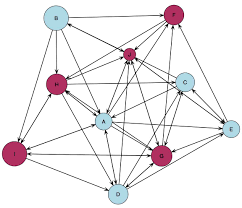
Bayesian causal networks—also known as Bayesian belief networks—are powerful probabilistic graphical models for representing and analysing complex multivariate systems under uncertainty. They integrate qualitative causal reasoning with quantitative data analysis, enabling robust inference, prediction, and decision-making.
This course provides a comprehensive introduction to the theoretical foundations and practical implementation of Bayesian causal networks using R. Participants will learn how to design, estimate, validate, and interpret causal models using real and simulated data. Through a combination of lectures, hands-on coding sessions, and guided interpretation, learners will build and evaluate a multivariate Bayesian network with at least 10 variables tailored to their own domain-specific questions.
The course is delivered online and structured to accommodate participants across multiple time zones, combining five interactive live sessions with practical exercises and supported self-study.
Target Audience and Assumed Background
This course is designed for:
-
Advanced undergraduate and Master’s students
-
Early-stage Ph.D. candidates
-
Professionals interested in causal modelling and probabilistic inference
The course is particularly relevant for participants working in ecological, environmental, and related data-driven disciplines.
Prerequisites
-
Familiarity with basic probability concepts
-
Prior experience using R (data manipulation, scripting, and running analyses)
-
Basic knowledge of statistical models and data cleaning in R is recommended to fully benefit from the advanced material
Learning Outcomes
By the end of the course, participants will be able to:
-
Distinguish between probability and likelihood in a Bayesian framework
-
Formulate and validate directed acyclic graphs (DAGs) representing causal assumptions
-
Perform structure learning and parameter estimation for Bayesian causal networks in R
-
Simulate data, conduct posterior inference, and perform sensitivity analyses
-
Interpret model outputs and communicate uncertainty for scientific and decision-making contexts
Program
The course combines live, synchronous sessions with hands-on practical work using annotated R scripts and example datasets. Each live session includes:
-
Conceptual lectures
-
Live coding demonstrations
-
Guided practical exercises
Additional self-directed exercises are provided, with remote support available to ensure flexibility for participants in different time zones.
-
Day 1- 3-6 PM Berlin time:: Framing scientific questions and causal assumptions; introduction to Bayesian causal networks
-
Day 2- 3-6 PM Berlin time:: Data preparation, discretisation strategies, and handling missing data
-
Day 3- 3-6 PM Berlin time:: Structure learning, whitelisting and blacklisting, and bootstrap model averaging
-
Day 4- 3-6 PM Berlin time:: Parameter learning (conditional probability tables), inference with evidence, and scenario analysis
-
Day 5- 3-6 PM Berlin time:: Model validation, predictive checks, sensitivity analysis, and presentation of results

Inscripciones
related courses
1- Dealing with messy data in R - ONLINE, 8-10 April
2- Handling Missing Data in R - ONLINE, 22-24 April
3- Network Analysis in R - ONLINE, 4-7 May
4 - Beyond Beginner R - ONLINE, 1-4 June
5 - Introduction to R Shiny - ONLINE, 9-10 June
6- Network Analysis in Systems Biology - ONLINE, 5-8 October
Should you have any further questions, please send an email to [email protected]
Cancellation Policy:
> 30 days before the start date = 30% cancellation fee
< 30 days before the start date= No Refund.
Physalia-courses cannot be held responsible for any travel fees, accommodation or other expenses incurred to you as a result of the cancellation.