
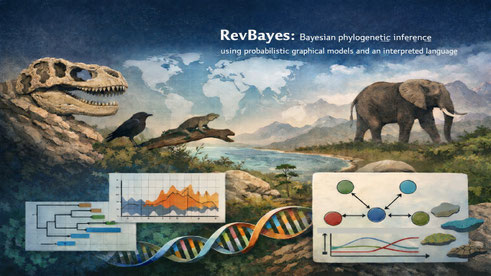
A hands-on course in Bayesian modelling and evolutionary analysis using RevBayes
Dates
21-24 April 2026
To foster international participation, this course will be held online
Course overview
Phylogenies are fundamental in many life science fields, from paleontology to molecular epidemiology. Inferring evolutionary processes from phylogenetic data is complex due to uncertainties in tree structure and hidden evolutionary events. Bayesian inference with Markov Chain Monte Carlo (MCMC) offers a powerful, flexible way to tackle these challenges.
This course introduces you to stochastic modelling in evolutionary biology using RevBayes, an open-source, R-like software designed for Bayesian phylogenetic inference with probabilistic graphical models. You will learn how to build and run models that uncover how lineages diversify, how geographic ranges evolve, and how evolutionary processes shape phylogenetic trees.
Through integrated lectures and practical sessions using real datasets, you’ll gain hands-on experience in specifying, running, and interpreting Bayesian evolutionary models. The course is ideal
for researchers and students seeking to deepen their understanding of phylogenetics beyond standard “black-box” methods.
Target Audience
This course is aimed at higher degree research students and early career researchers working with or interested in evolutionary biology, phylogenetics, and Bayesian modelling. Some familiarity
with phylogenetic concepts such as trees, branch lengths, and substitution models is assumed.
Learning outcomes
By the end of the course, you will be able to:
-
Understand the foundations of Bayesian inference and MCMC in evolutionary analysis
-
Use RevBayes scripting language to specify and run Bayesian phylogenetic models
-
Model biogeographic history of lineages, including DEC models and stochastic mapping
-
Apply comparative biogeographic models such as Bayesian Island Biogeography (BIB)
-
Implement and interpret diversification models within a birth–death framework
-
Critically assess assumptions and outputs of Bayesian phylogenetic analyses
Session content
Daily on-line meetings, 14:00-19:00 Berlin time; offline communication through Slack.
Day 1. Foundations of Bayesian inference
Introduction to Bayesian inference, including Bayes’ theorem, priors and posterior distributions, and Markov Chain Monte Carlo (MCMC) methods. Participants will become familiar with the RevBayes language through simple examples and exercises, including mathematical operations and programming constructs (e.g. loops). Practical sessions will introduce conditional probability, exploration of priors, and the use of directed acyclic graphs (DAGs) to represent models, as well as the distinction between stochastic, deterministic, and fixed nodes in the Rev language.
Day 2. Biogeographic modeling
Using phylogenetic trees to infer the spatio-temporal evolution of lineages. Participants will be introduced to parameters and dependencies in biogeographic DAGs, and will learn how biogeographic processes are represented within a Bayesian framework. Practical sessions will involve implementing the DEC model in RevBayes to analyse the biogeographic history of a single lineage, including simple DEC models, stratified (epoch-based) DEC models, and biogeographic stochastic mapping.
Day 3. Comparative biogeographic modeling
Building on Day 2, participants will explore how biogeographic patterns can be inferred across multiple lineages. The day will introduce the Bayesian Island Biogeography (BIB) model and focus on estimating lineage- and area-specific colonisation rates, as well as assessing correlations between biogeographic processes and environmental factors.
Day 4. Diversification modeling
This day introduces diversification processes within a birth–death modelling framework. Participants will learn how constant-rate, time-varying, and clade-varying diversification models are formulated and interpreted. Practical sessions will focus on implementing constant, episodic, environmentally dependent, and branch-specific birth–death models in RevBayes to investigate patterns of lineage diversification.


COst overview
related courses
1- Deep Learning in Population Genomics & Phylogeography - ONLINE, 23-26 March
2 - Species distribution modeling with Bayesian additive regression tree (BART) methods - ONLINE, 1-3 July
Cancellation Policy:
> 30 days before the start date = 30% cancellation fee
< 30 days before the start date= No Refund.
Physalia-courses cannot be held responsible for any travel fees, accommodation or other expenses incurred to you as a result of the cancellation.