
MicroRNA Annotation and small RNA-Seq Analysis
Dates
6-9 October 2026
To foster international participation, this course will be held online
Course overview
This course provides a practical introduction to small RNA sequencing (sRNA-seq) and microRNA annotation, covering the full workflow from raw sequencing data to curated microRNA gene
complements.
MicroRNAs are key post-transcriptional regulators of gene expression that control mRNA stability and translation. Their discovery was recognized with the Nobel Prize in Physiology or Medicine
2024, highlighting their fundamental role in development, evolution, and disease. However, accurate identification has proofed difficult and requires combining sequencing data, genome context,
and well-defined annotation criteria.
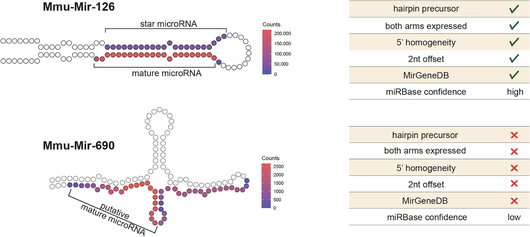
In this course, participants will learn how to process small RNA-seq data, reproduce analyses from published studies, and perform rigorous annotation of bona fide microRNAs using established
tools and standards.
The course is fully hands-on and based on real datasets and published analyses.
Target Audience
- Basic knowledge of small RNA biology (e.g. microRNAs) and genomics
- Familiarity with the Unix/Linux command line (bash) and conda
- PhD students and postdocs in genomics, molecular biology, or bioinformatics
- Researchers working with RNA-seq or non-coding RNAs
- Anyone interested in microRNA biology and annotation
Learning outcomes
Participants will gain the practical skills to:
- Analyze small RNA-seq data
- Reproduce published analyses from finding to downloading to processing the data
- Perform microRNA annotation using current best practices
- Critically evaluate published and newly predicted microRNAs
Session content
Day1 – Introduction & QC of small RNA-Seq data - 12-5 PM Berlin time
• Overview of small RNA sequencing and microRNA biology
• FASTQ format and sequencing quality
• Quality control using miRTrace
• Hands-on QC and interpretation of real datasets
Day2 – From Paper to Data to Figure - 12-5 PM Berlin time
• How to navigate a published small RNA-seq study and reproduce analyses
• Retrieving data from public repositories
• Reproducing key analysis steps from a paper
• Generating figures from raw or processed data
• Comparing results to published findings
Day3 – MicroRNA Annotation Workflow - 12-5 PM Berlin time
• Principles of microRNA annotation
• Annotation pipeline using MirMachine, miRTrace, and MirMiner
• From raw data to candidate microRNAs
Day4 – Validation and Curation- 12-5 PM Berlin time
• Criteria for bona fide microRNAs
• Identification of false positives and missing microRNAs
• Manual curation and best practices for novel microRNA identification

COst overview
related courses
1 - Metatranscriptomics - ONLINE, 27-29 April
2 - Gene Set Enrichment Analysis in R - ONLINE, 11-15 May 2026
3 - RNAseq for beginners - ONLINE, 20th-28th of May
4 - Spring School in Bioinformatics- ONLINE, 8-12 June
5 - Sex Chromosome Evolution - ONLINE, 12-16 October
Cancellation Policy:
> 30 days before the start date = 30% cancellation fee
< 30 days before the start date= No Refund.
Physalia-courses cannot be held responsible for any travel fees, accommodation or other expenses incurred to you as a result of the cancellation.